> For the complete documentation index, see [llms.txt](https://docs.tlic.cmu.ac.th/cmu-mango-canvas-manual/llms.txt). Markdown versions of documentation pages are available by appending `.md` to page URLs; this page is available as [Markdown](https://docs.tlic.cmu.ac.th/cmu-mango-canvas-manual/quizzes-and-assignment/new-quizzes/multiple-choice-new-quizzes.md).
# Multiple Choice (New Quizzes)
A multiple-choice question has only one correct answer.
## Adding Question
\[1] Question Title (invisible to students)
\[2] Question Stem
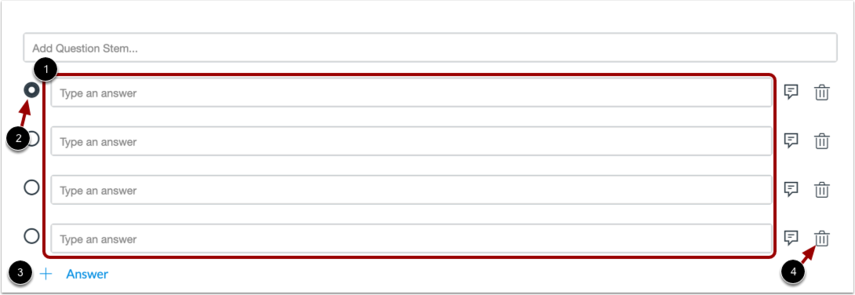
## Adding Answer
\[1] All answers
\[2] Select the correct answer
\[3] Add an answer
\[4] Delete the answer
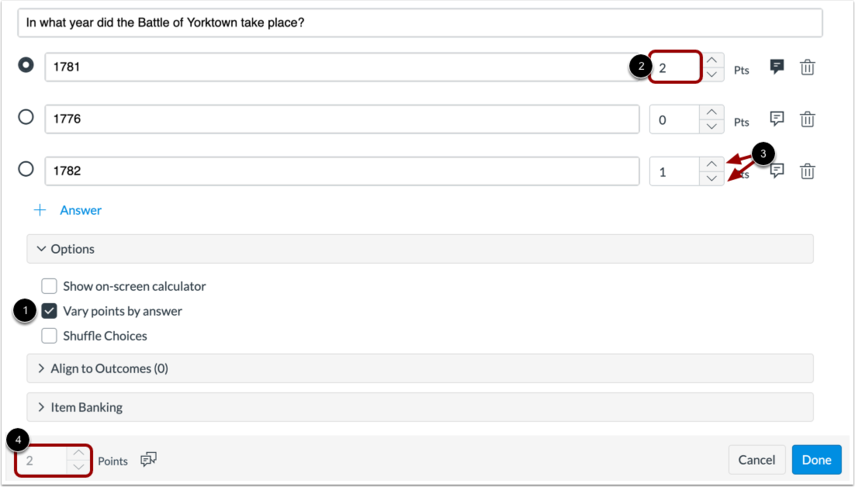
## Vary Points by Answer
Click at \[1] to vary the points by answer
Enter the score at \[2] or use the arrow buttons to increase/decrease the score \[3].
When using this option, the score displayed in \[4] will be the maximum possible score for this question.
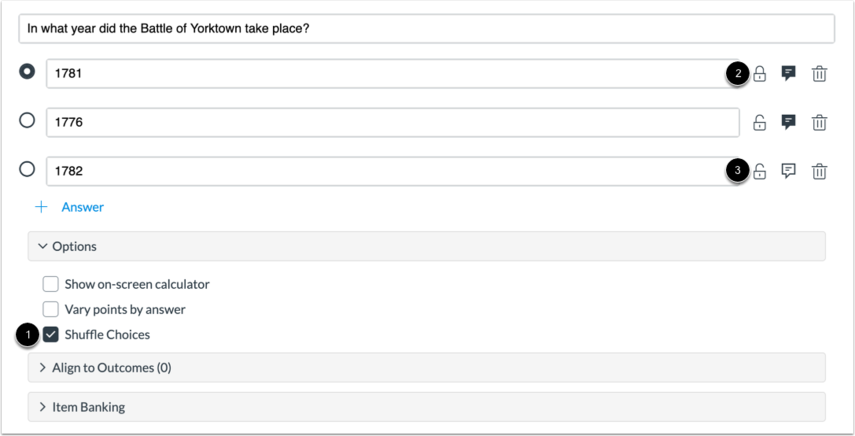
## Shuffle Choices
\[1] Select this option to shuffle the choices
\[2] Lock position to prevent the item from being shuffled.
\[3] Unlock the position
## Video Tutorial for Multiple Choice
{% embed url="" %}