> For the complete documentation index, see [llms.txt](https://docs.tlic.cmu.ac.th/cmu-mango-canvas-manual/llms.txt). Markdown versions of documentation pages are available by appending `.md` to page URLs; this page is available as [Markdown](https://docs.tlic.cmu.ac.th/cmu-mango-canvas-manual/quizzes-and-assignment/new-quizzes/fill-in-the-blank.md).
# Fill in the blank
Fill in the blank is a type of question that requires filling in the missing word(s) in a sentence. There can be more than one blank space, and the answer can be of various types.
This type of question can be scored separately for each blank space. For example, in this quiz, each blank space is worth 1 point, and there are 4 blank spaces. Therefore, each blank space is worth 0.25 points. When a learner answers correctly in 2 blank spaces and incorrectly in 2 blank spaces, the total score will be 0.50 points.
### Types of Answers
* Open Entry
* Dropdown
* Word Bank (Drag and Drop)
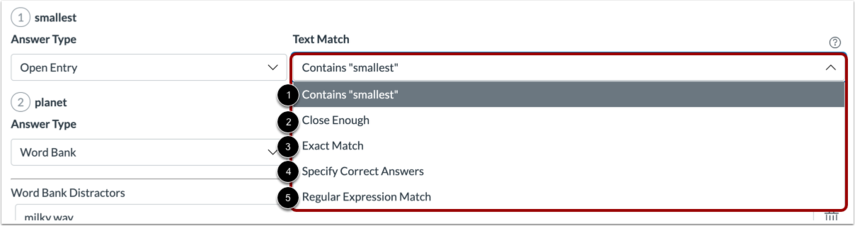
### Text Match (Only for Open Entry)
* **Contains:** Contains option allows learners to respond in any way they choose, as long as the answer is spelled correctly. For example, if the correct answer is "panda," typing "It's panda" will be considered correct and receive points. However, typing "Panda" will be marked as incorrect and not receive points.
* **Close Enough:** The system uses Levenshtein Distance to check for answers that are close to the correct answer (suitable for English answers).
* **Exact Match:** Students must type the exact answer to receive points.
* **Specify Correct Answers:** Additional acceptable answers can be specified, such as lowercase/uppercase letters.
* **Regular Expression Match:** Regular expressions are used to assist in checking answers, which may not be suitable for basic users. [read the Regular Expression Wikipedia entry](https://en.wikipedia.org/wiki/Regular_expression).
## Video Tutorial for a Fill in the Blank
{% embed url="" %}