> For the complete documentation index, see [llms.txt](https://docs.tlic.cmu.ac.th/cmu-mango-canvas-manual/llms.txt). Markdown versions of documentation pages are available by appending `.md` to page URLs; this page is available as [Markdown](https://docs.tlic.cmu.ac.th/cmu-mango-canvas-manual/quizzes-and-assignment/new-quizzes/matching.md).
# Matching
Matching questions require learners to select the correct answer from a dropdown menu. This type of question allows partial scoring, or learners may need to answer all parts correctly to receive a score.
## Adding Question/Answer Pair
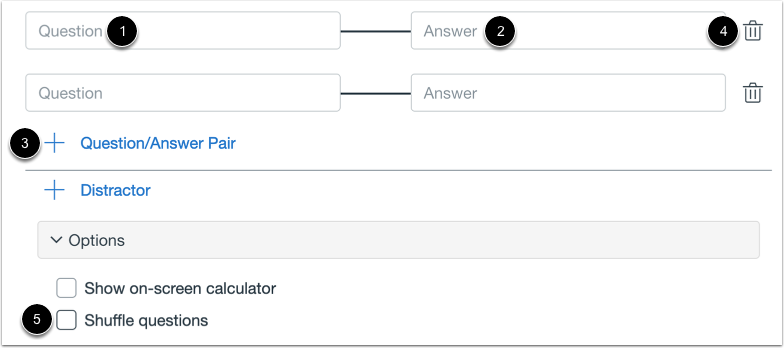
\[1] Question input
\[2] Answer input
\[3] Question/Answer pair addition
\[4] Button for deleting questions/answer pair
\[5] Shuffle questions option
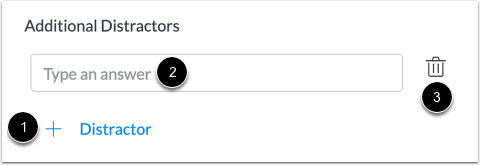
To add distractors, click on \[1] and type the answer at \[2] or delete \[3].
## Grading Options
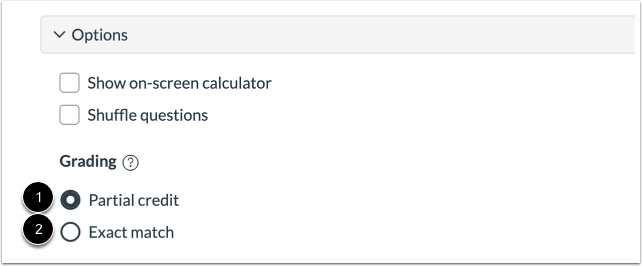
\[1] Partial credit with a possible minimum score at 0
Example: A question is worth 4 points and has 2 correct answers. The system will automatically allocate 2 points for each correct answer. If a student answers 1 question incorrectly and 1 question correctly, they will receive a total of 2 points.
\[2] Students must answer all pairs correctly in order to receive points.
## Video Tutorial for Matching
{% embed url="" %}